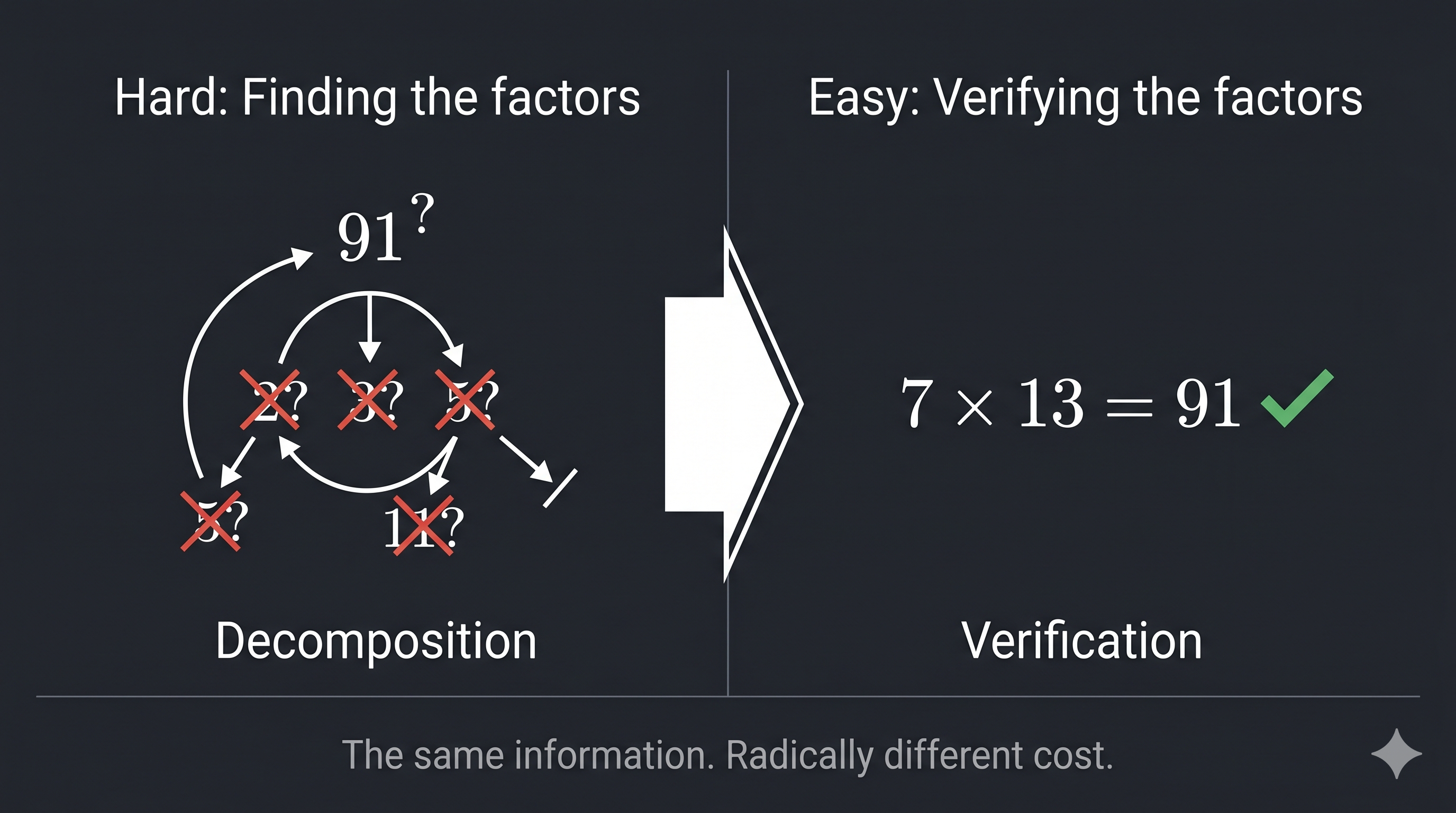
The Asymmetry
Two emails arrived on the same morning last week.
The first was four paragraphs long. It opened with background I already knew, wandered through a description of several problems without distinguishing which ones mattered, and ended mid-thought — no clear ask, no proposed next step. I read it twice and still wasn't sure what I was supposed to do. The sender had emptied their head into my inbox, and the work of organizing their thoughts was now mine.
The second was three sentences. It stated the problem, proposed a solution, and asked for my sign-off by Thursday. I read it once, replied in thirty seconds, and moved on.
Same medium — text in a rectangle on my screen. Completely different experience. One was like drawing in a breath and finding oxygen. The other was like drawing in a breath and finding nothing.
The Factoring Problem
There's an operation in mathematics called prime factorization. Given a large number, find the primes that multiply together to produce it. It's famously hard — so hard that modern cryptography depends on it. But here's the thing: verifying the factors is trivial. If I tell you that 7 × 13 = 91, you can confirm it in your head. Finding those factors in the first place is where the work lives.