The Asymmetry#
Two emails arrived on the same morning last week.
The first was four paragraphs long. It opened with background I already knew, wandered through a description of several problems without distinguishing which ones mattered, and ended mid-thought — no clear ask, no proposed next step. I read it twice and still wasn't sure what I was supposed to do. The sender had emptied their head into my inbox, and the work of organizing their thoughts was now mine.
The second was three sentences. It stated the problem, proposed a solution, and asked for my sign-off by Thursday. I read it once, replied in thirty seconds, and moved on.
Same medium — text in a rectangle on my screen. Completely different experience. One was like drawing in a breath and finding oxygen. The other was like drawing in a breath and finding nothing.
The Factoring Problem#
There's an operation in mathematics called prime factorization. Given a large number, find the primes that multiply together to produce it. It's famously hard — so hard that modern cryptography depends on it. But here's the thing: verifying the factors is trivial. If I tell you that 7 × 13 = 91, you can confirm it in your head. Finding those factors in the first place is where the work lives.
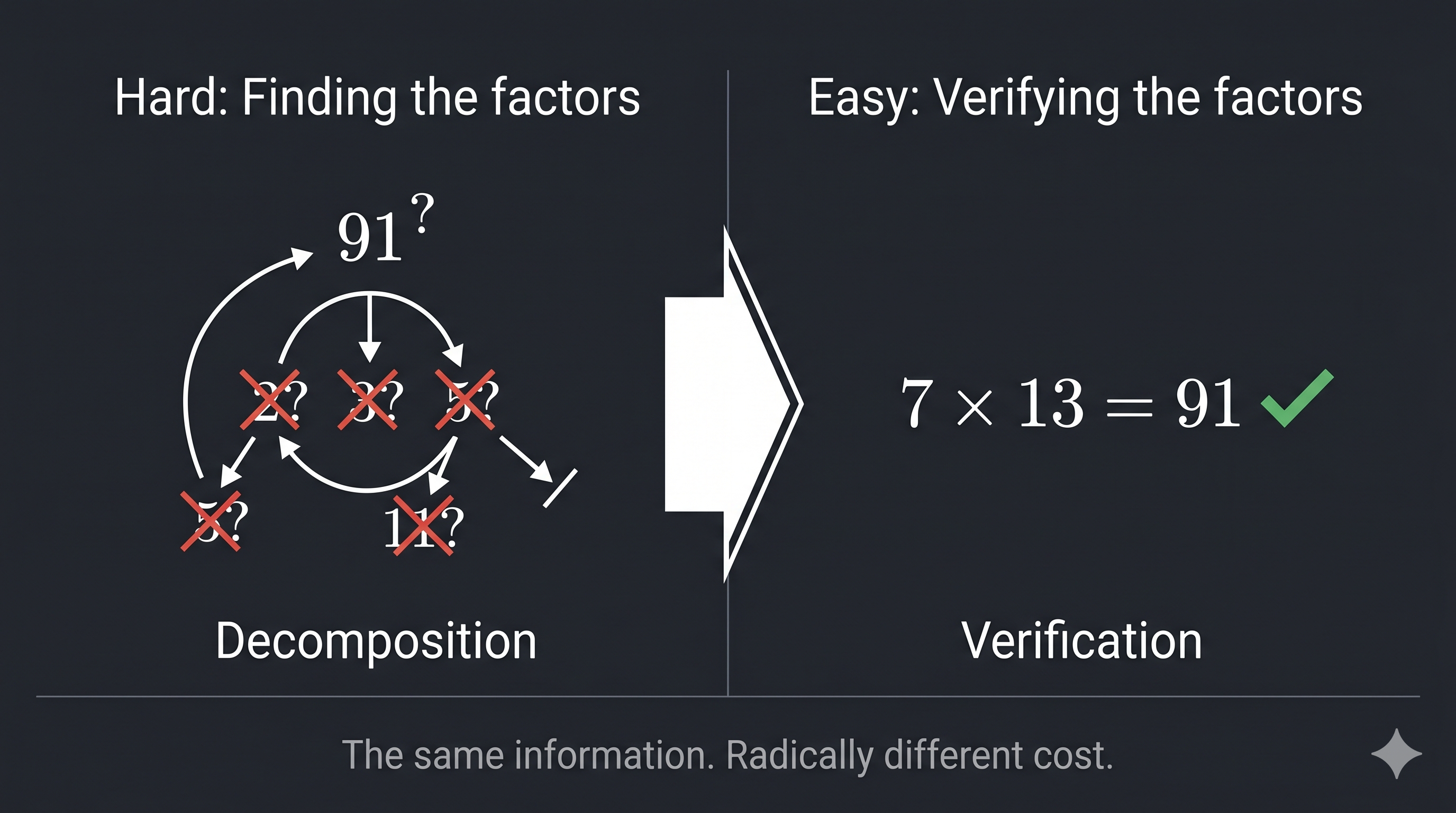
Good cognitive work has this same asymmetry. It's expensive to produce and cheap to consume. A well-written article, a well-run meeting, a clear email — these are things where someone did the hard work of analysis, synthesis, and organization upstream so that the receiver doesn't have to. The reader, the attendee, the recipient gets the factors. They can verify, engage, build on top. The complexity was absorbed before it reached them.
This is what it feels like to read something that makes you smarter: the author did the factoring, and you get to do the multiplication. You leave the interaction with more than you came in with. It feels like oxygen because it is — metabolizable thought, ready to use.
The Inversion#
Slop — in every medium — inverts this asymmetry.
The producer does the cheap part: they generate volume. Words in a Slack message. Slides in a deck. Attendees in a meeting. An hour of someone's voice in a recording. The expensive part — figuring out what's actually useful, what the point is, what action should follow — gets transferred to the receiver. The sender saved themselves five minutes of thought and cost you thirty minutes of interpretation.
A meeting with no agenda is unfactored work. The organizer didn't do the hard thinking about what needs to be decided, so everyone in the room has to do it together, in real time, expensively. A Slack message that ends with "..." is an unfactored request — the sender hasn't finished their own thought but has already conscripted you into completing it. A rambling email is someone offloading the cost of organizing their ideas onto whoever opens it.
And it's not just informal communication. A report that buries its conclusion on page twelve. A LinkedIn post that takes six paragraphs to say nothing. A status update that recites activity without revealing progress. These all have the same shape: the author did the easy part and left you with the hard part.
Here's the same project, the same week, written two ways:
The Q3 marketing campaign is progressing. We've had several meetings with the agency to discuss creative direction. The team is reviewing media buy options. Some concerns came up about the budget that we're looking into. We're also coordinating with legal on the new disclaimer language. Overall things are on track and we'll have more updates next week.
You read that. What do you know now? What decision can you make? Nothing. You've consumed someone's time without receiving their thinking. Now read this:
Q3 campaign is a week behind schedule. The agency delivered three creative concepts — we've approved one and sent revision notes on the hero video, due back Wednesday. Media buy is $15K over budget because cable rates increased. Legal approved the disclaimer language. Decision needed: do we cut the print placement to stay on budget, or request the additional $15K?
Same project. Same week. The first version transfers all the cognitive work to you. The second arrives with the factors already extracted — what's late, what's done, and what you need to decide. One is a deposit. The other is a withdrawal disguised as a deposit.
This isn't about doing all the thinking alone. A leader who brings a clearly framed problem to a working group — here's what's broken, here's why it matters, here's what we need to figure out — has done their factoring. The problem is defined, the stakes are clear, and the team's role is to factor the solution. That's not offloading. That's delegation. The inversion happens when the problem itself hasn't been factored — when the audience has to figure out not just the answer but the question.
The Director Test#
I've spent years advising people who want to advance in large organizations, and there's a pattern I keep coming back to.
Non-directors bring you a problem. They walk into your office, describe what's broken, and look at you. The implicit request is: think about this for me. They've done the multiplication — they've identified that 91 is a number that matters — but they haven't factored it. Now it's your problem.
Directors bring you the problem, a proposed solution, the thinking that led to that solution, and a simple request for borrowed authority to implement it. They hand you 7 × 13 and say: "I need your sign-off to proceed." Same information. Radically different cognitive load. The director absorbed the expensive part before they walked through the door.
This isn't about seniority. I've seen junior engineers who factor beautifully and executives who can't organize a thought before they broadcast it. The asymmetry is a skill, not a rank. And like most skills, the first step is noticing it exists.
The Guitar Amp#
This is where AI enters the picture — and where the asymmetry gets sharper, not duller.
AI is a guitar amp. It makes you louder, not better. If you can play, more people hear something worth hearing. If you can't, more people hear that you can't. An expert who uses AI to research, draft, analyze, and refine is doing more factoring, not less. They're using the tool to absorb even more complexity before it reaches the audience. The output is denser, clearer, more thoroughly considered — because the human brought expertise and the machine brought scale.
But someone without the discipline to do the thinking produces slop at scale. They generate volume faster, more confidently, and with better formatting. The output looks factored. It has the shape of organized thought: clear paragraphs, bullet points, professional tone. But the expensive work was never done. Nobody decided what actually matters. Nobody filtered, prioritized, or applied judgment. The receiver opens it, reads it, and slowly realizes they're breathing vacuum.
The wave of "AI slop" complaints is real, and some of it is earned. People are drowning in AI-generated content that looks polished but says nothing — emails, reports, LinkedIn posts that have the shape of organized thought without the substance. If you're tired of breathing vacuum, you should be. That's not a complaint about AI. It's a complaint about unfactored work produced at new scale.
But there are two complaints hiding in "AI slop." One is about quality — this work is bad — and that's fair. It was bad before AI made it cheaper to produce. The other is about provenance: this was made with AI. That's the tell. Scanning for emdashes, flagging "certainly" and "moreover," treating typographic habits as a forensic test for whether a machine was involved — all to avoid the harder question of whether the work is actually good. When the objection isn't that the work is bad but that AI touched it, the person is admitting they can't evaluate the output on its merits — they need to know the process to judge the product. An expert reads AI-assisted work and knows immediately whether the thinking was real. The provenance is irrelevant.
The tool doesn't change the asymmetry. It reveals who was already doing the factoring and who was getting away without it.
The Obligation#
You have a factoring machine. Ship factored work.
Every message, meeting, article, and interaction is a claim on someone else's attention. That claim carries an obligation: absorb the complexity before you transfer it. Do the factoring. Show up with the primes, not the product.
The tools for doing this have never been better. You can draft, research, analyze, reorganize, pressure-test, and refine your thinking at a speed that was unimaginable five years ago. The cost of producing well-factored work has collapsed. Which means the bar for what's acceptable has risen — or should have.
If you send a meeting invite, include the decision that needs to be made. If you send a message, finish your thought before you hit send. If you write a report, put the conclusion first. If you write an email, know what you're asking before you start typing.