The Cost of Software Is Now Zero#
A survival rubric for software and SaaS entrepreneurs in the era of vibe coding.
In February 2025, we published The AI-Driven Transformation of Software Development. Our central thesis: AI would trigger a fundamental shift in the build-versus-buy calculus, accelerating a "Cambrian explosion of software" and driving development costs toward zero. We predicted that businesses would find building tailored solutions increasingly cost-effective and strategically superior to purchasing off-the-shelf software.
The thesis has played out. The cost of code is, for most practical purposes, zero.
What's Actually Happening Out There#
We sat with two business owners last week. The conversations were different in detail but identical in conclusion: both had stopped buying software.
One is building a complete property management operating system: property records, CRM, fleet tracking, risk management, financials, task management, and more. Not a subscription he configured — a system his company owns outright, built for exactly how his operation works. He built it in two weeks — what would have cost $200,000 a year to rent from a vendor.
The other runs a retail chain. Someone on his team has been working through the software stack systematically — not one big build, but a rolling replacement of every tool they'd been renting. He's already cut $300,000 in annual costs. He's roughly halfway through. When the last subscription is gone, he's asked us to review the whole thing before it goes live — security, scalability, and production robustness.
Operators are replacing project management tools, CRMs, inventory systems, client portals — the entire layer of workflow software that SMBs have been renting for decades. Not because they became developers. Because describing software and building software are now the same thing.
The savings compound at exit. At a typical acquisition multiple, a $300,000 annual reduction in software costs adds over a million dollars to the sale price.
Now look at the same picture from the other side — the side trying to sell software to these operators.
One Million Vibecoders Writing the Same Thing#
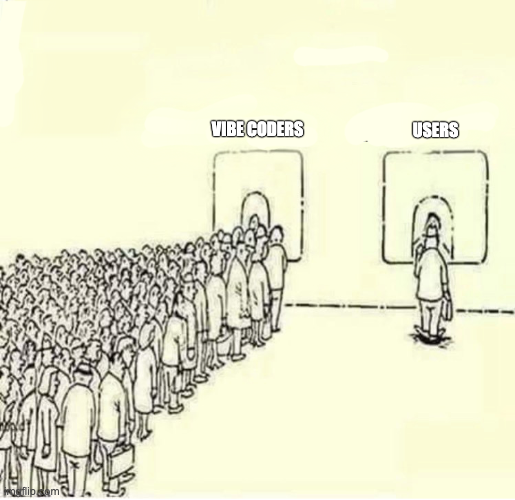
A million people are building ERP systems. A million people are building project management tools. A million people are building CRMs. They're all working on the same categories, pouring effort into software they intend to sell — and none of them have a market. Because anyone who wants that software will just build their own.
The vibecoders building products to sell are wasting their time. Their potential customers have the same tools they do.
The only vibecoders whose code actually gets used are the ones who are also the users: owner/operators building custom software for their own businesses. That ERP built specifically for one company's workflows, by the person running that company — it doesn't need to find a customer. It already has one.
This is the dividing line. Vibe coding is not a new software business model. It's the tool that lets operators stop being software customers.
The businesses in trouble aren't failing because they have bad products. They're failing because the people who used to buy from them have a better option: build it themselves, tailored to their exact needs, with no recurring subscription.
The Question That Follows#
If code is free to produce, software businesses that sell code lose their moat.
The value proposition was never really the software itself. It was the arbitrage: someone already built this, so you don't have to pay a developer. That arbitrage is gone. The operator with a weekend and a capable AI assistant can now build exactly what they need, perfectly suited to their workflow, with no recurring subscription cost.
Not all software businesses face this. The ones selling code packaged as a product are in trouble. The ones that were always selling something else — using software as the delivery mechanism — are fine. Some are better than ever.
The question every founder needs to answer honestly: if code were free, would anyone still buy from us?
What Survives#
Twenty years ago my colleague John Cage introduced me to Treacy and Wiersema's Value Disciplines. Operational Excellence, Product Leadership, Customer Intimacy — pick one to dominate, maintain threshold in the others. I've applied it to every strategic engagement since. Vibe coding just took one of the three off the table.
Operational Excellence. Competing on lowest cost and highest efficiency has been the dominant strategy for SMB SaaS. It's no longer defensible. When an operator can build exactly what they need at zero recurring cost, "cheaper than building it yourself" isn't a position.
Product Leadership survives — if the complexity is real. Feature-rich workflow software doesn't qualify. Genuine product leadership means ML models, optimization systems, domains that require years of specialized expertise to build correctly. A vibe-coded app can approximate a dashboard. It can't approximate a decade of algorithmic research.
Customer Intimacy not only survives, it wins. Anywhere the deliverable is judgment, accountability, or trusted expertise — with software as the delivery mechanism rather than the product. Cheap code helps these businesses. They deliver faster, operate leaner, and take on more clients with the same team. The operators winning here aren't the ones handing everything to AI — they're the domain experts who can supervise it. That's precisely why they're winning.
Two additional categories fall outside the disciplines but are equally defensible:
Regulatory and compliance moats. Healthcare software, financial systems, anything requiring liability acceptance, certifications, or audit trail requirements. A vibe-coded replacement might replicate the features. It won't replicate the compliance posture.
Infrastructure position. The picks-and-shovels layer that vibe-coded applications depend on: authentication, payments, deployment, APIs, databases. Network effects live here too — platforms where years of data and an embedded partner ecosystem make migration genuinely expensive. Vibe coding expands this market, not shrinks it.
The Rubric#
Score your business across seven dimensions. Add them up.
| Dimension | 1 — Exposed | 2 — Mixed | 3 — Defensible |
|---|---|---|---|
| Value Delivery | Software is the product. Customers pay for features. | Software enables a service. Code and expertise blend. | Judgment, trust, or accountability is the product. Software is delivery. |
| Switching Cost | Data is portable. No integrations, no ecosystem. | Meaningful friction: data history, integrations, learned workflows. | Network effects or regulatory data residency. Migration is genuinely expensive. |
| Compliance Moat | No requirements. Anyone can build a replacement. | Compliance matters, but a determined operator could manage it. | Certifications, liability acceptance, audit trails. Vibe coding can't satisfy these. |
| Problem Complexity | Forms, dashboards, CRUD. Buildable in a weekend. | Non-trivial integrations or moderate algorithmic depth. | ML, optimization, real-time systems. Years of specialized expertise required. |
| Buyer Profile | SMB operators — the people now building their own tools. | Mid-market with some IT governance. | Regulated enterprises, governments. Procurement and legal sit between you and replacement. |
| Layer | End-user application for a specific use case. | Platform with some application features. | Infrastructure that vibe-coded apps depend on. |
| Proprietary Data / Content / IP | No proprietary data or IP. Anyone starting from scratch would reach feature parity quickly. | Some accumulated data advantage — user history, transaction data — but replicable with time and effort. | Proprietary datasets, content licenses, or IP that cannot be recreated from scratch. The asset is the moat. |
Reading Your Score#
| Total | What it means |
|---|---|
| 7–12 | Pivot urgently. You're in Operational Excellence territory — the discipline vibe coding just ended. |
| 13–17 | Reinforce or reposition. You have assets but meaningful exposure. Identify which dimensions can be strengthened. |
| 18–21 | Press the advantage. You're operating in Customer Intimacy, Product Leadership, or infrastructure. Double down. |
Two Examples#
Monday.com scores a 10. It's a $10 billion company. It's also a work management application — forms, boards, and status columns with a clean interface. No compliance requirements. No proprietary data. No algorithmic depth that requires years to build. Its switching cost scores a 2 because workflows and integrations create some friction, but nothing that survives a determined replacement effort. The rubric doesn't care about revenue multiples. A tool called Zapta already lets teams feed in their Monday.com API token and vibe-code a custom replacement — database, authentication, and all — for $29 a month.
Stripe scores a 21. Every dimension is defensible, and most reinforce each other. The compliance posture is what creates the enterprise buyer. The enterprise buyer generates the transaction data. The transaction data trains the fraud models. The fraud models deepen the moat. A vibe coder building a payments app doesn't compete with Stripe — they depend on it.
The M&A market is already pricing this divergence in. Q1 2026 data shows that in vertical software acquisitions, revenue growth carries 2.4 times the predictive weight of EBITDA margins in explaining valuation outcomes. Buyers are paying for stickiness — which is another way of saying they're paying for defensibility.
What This Means#
Most software businesses were built on the assumption that code was scarce. It isn't anymore.
The question in the middle of this article — if code were free, would anyone still buy from us? — isn't rhetorical. Run the rubric. If you're scoring in the 7–12 range, the answer is no, and your replacement isn't a competitor. It's your customer.
LIT AI helps technology businesses navigate this shift. If your rubric score raised questions about your position — or if you're building the thing that replaces someone else's and want it done right — let's talk.